
Choosing Homeschool Curriculum & Resources That Fit Your Family
Choosing the right homeschool curriculum sounds like a big project, but it doesn’t have to be. Start by thinking about how your child responds to different types of instruction and activities, as well as your own teaching preferences. Does your child enjoy hands-on activities? Do they prefer clear instructions and predictable lessons? Maybe a mixture of different approaches works best.
The amount of structure your family wants is also important. Some families prefer a consistent daily schedule, while others take a more flexible approach. Knowing what works for your household can help narrow down the many curriculum options available.
You might choose a complete curriculum that provides most of what you need, select separate programs for individual subjects, or build your own combination of books, online resources, activities, games, and hands-on materials.
Before committing to a curriculum, look for sample lessons, free trials, demonstrations, or previews when they’re available. These can give you a better idea of how the material actually works before you invest in it. Pay attention to what works well for your child and what causes unnecessary frustration.
There is no single homeschool curriculum that works for every family. Your choices can change as your child’s needs, interests, and abilities change. A curriculum is a resource—not a commitment you have to keep using when it no longer works for your family.
Explore how to choose homeschool curriculum →
Curriculum Planning
Homeschool curriculum planning doesn’t have to mean scheduling every lesson for the entire year before you begin.
Start with the subjects and skills you want to address, then decide which resources can help you accomplish those goals. Some families plan by semester or school year, while others plan a few weeks at a time.
Leaving room for flexibility can make it easier to slow down when a child needs more time, move ahead when they’re ready, or explore an unexpected interest.
Your curriculum plan can provide direction without controlling every part of your homeschool.
Explore homeschool curriculum planning →
Finding and Evaluating Homeschool Resources
Homeschool resources can include much more than traditional textbooks and workbooks.
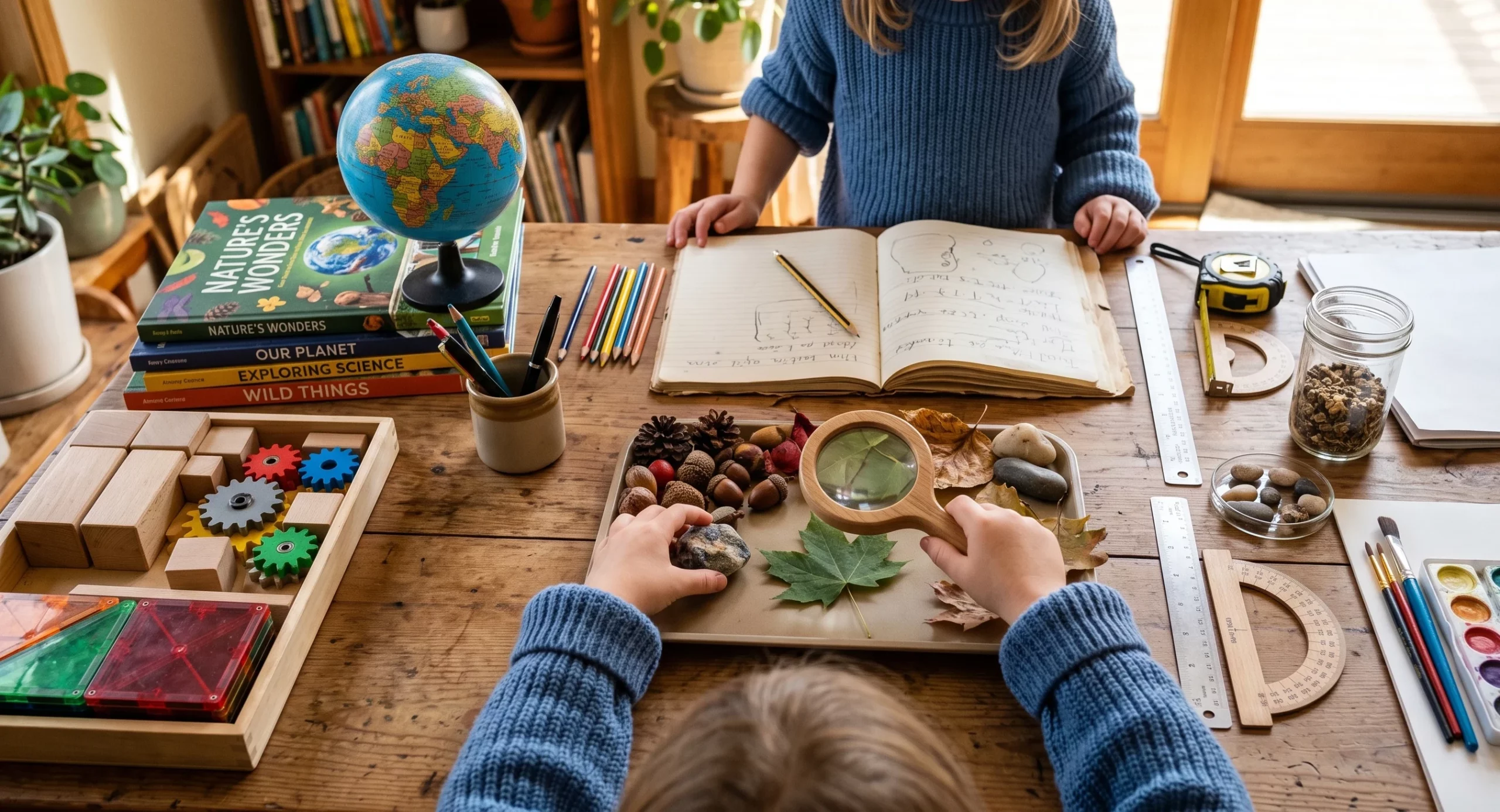
Books, websites, educational videos, documentaries, apps, games, manipulatives, science kits, art supplies, online classes, community programs, museums, libraries, and other resources can all become part of your homeschool.
Before purchasing something, consider how it will actually be used. Does it fit your child’s current abilities? Is it something your child is likely to engage with? Does it require significant preparation from you? Will you use it regularly enough to justify the cost?
You can also browse Amazon’s homeschool and educational resources for books, curriculum, science kits, manipulatives, art supplies, and other materials that fit your family’s needs.
Being selective can help you build a useful collection of resources without filling your shelves with materials you rarely use.
LINK: Explore homeschool resources →
Core Homeschool Subjects
Curriculum can provide structure and resources for the subjects you want to include in your homeschool. You can use a complete program, combine resources from several sources, or approach different subjects in completely different ways.
Reading & Language Arts
Reading and Language Arts can include reading, writing, spelling, grammar, vocabulary, communication, and literature.
Start by considering what your child enjoys reading or writing about. Some children enjoy adventurous stories or imaginative fiction, while others gravitate toward nonfiction about subjects that already interest them. Writing might take the form of stories, journals, poems, comics, letters, reports, or digital projects.
You don’t have to rely on a single program. Curriculum can be combined with literature, independent reading, audio books, writing projects, word games, and reading aloud together.
Look for opportunities to connect language arts with your child’s interests. A fascination with animals might lead to nonfiction reading and writing about a favorite species. A child who enjoys storytelling might write and illustrate their own book.
Language arts doesn’t have to remain confined to textbooks and worksheets.
Explore homeschool reading and language arts resources →
Math
Math is found throughout everyday life, from cooking and shopping to building, coding, games, and managing money.
A structured math curriculum can provide a useful progression of concepts and skills, particularly because many mathematical concepts build upon earlier ones. However, curriculum doesn’t have to be the only way children encounter math.
Cooking can provide experience with fractions and measurement. Shopping introduces money, comparison, percentages, and budgeting. Building projects can involve measurement and geometry. Games can encourage arithmetic, probability, logic, and strategic thinking.
Hands-on materials and real-world experiences can also help children see how mathematical concepts are used outside a lesson.
Rather than focusing only on getting the correct answer, encourage children to understand how they reached it and why a particular solution works.
Explore homeschool math curriculum and resources →
Science
Homeschool science can include structured curriculum, experiments, observation, documentaries, books, nature study, museums, science kits, and questions that arise during everyday life.
Hands-on exploration can be especially useful for connecting scientific concepts with things children can observe and investigate themselves.
A question about an insect in the backyard might lead to biology. Looking at the night sky can lead to astronomy. Growing a garden can introduce botany, ecology, weather, soil science, and insects.
Families can choose a comprehensive science curriculum, focus on individual branches of science, or combine formal lessons with hands-on exploration.
LINK: Explore homeschool science curriculum and resources →
Social Studies & History
Social studies can encompass history, geography, government, economics, cultures, communities, and how people interact with the world around them.
Curriculum is one option, but books, maps, biographies, documentaries, museums, historical sites, cultural events, timelines, and family discussions can all contribute to learning.
Children can also explore history and social studies through subjects that already interest them. Mythology can lead to ancient civilizations. Food can lead to geography and culture. A family trip can inspire research into local history.
Using multiple resources can help children explore events, places, cultures, and people from different perspectives.
LINK: Explore homeschool social studies and history resources →
Creative and Hands-On Learning Resources
Not every subject needs to center around textbooks or worksheets. Creative projects, experiments, games, building materials, and other hands-on resources can give children additional ways to explore ideas and develop skills.
Art & Music
Art and music can be explored through formal lessons, but they can also grow naturally from a child’s interests.
Drawing, painting, photography, sculpture, crafts, digital art, singing, instruments, music appreciation, and music creation can all become part of homeschooling.
Books, videos, online lessons, local classes, museums, performances, and basic art or music supplies can provide opportunities to explore without requiring an elaborate curriculum.
LINK: Explore homeschool art and music resources →
STEM
STEM combines science, technology, engineering, and mathematics and can be particularly well suited to projects and experimentation.
Building kits, robotics, coding, engineering challenges, science experiments, electronics, 3D design, and construction projects can encourage children to test ideas, solve problems, and create things.
STEM resources range from structured curriculum and kits to household materials that can be used for simple experiments and engineering challenges.
LINK: Explore homeschool STEM resources →
Hands-On Learning Materials
Hands-on learning materials give children opportunities to interact with the concepts they’re exploring.
Manipulatives, microscopes, science equipment, maps, globes, puzzles, models, building materials, art supplies, gardening tools, measuring tools, and educational kits can all support different areas of learning.
You don’t need a house full of educational supplies. Choose materials that support current interests or subjects and that are likely to be used more than once whenever possible.
LINK: Explore hands-on homeschool resources →
Educational Games & Learning Through Play
Games can provide opportunities to practice skills and explore concepts in a low-pressure environment.
Board games, card games, role-playing games, puzzles, strategy games, and digital games can involve reading, mathematics, logic, problem-solving, communication, creativity, planning, and decision-making.
Not every game needs to be labeled “educational” to involve learning. Pay attention to the skills children are actually using while they play.
Family game nights can also create opportunities for cooperation, strategic thinking, communication, and learning together.
Explore educational games and learning through play →
You Don’t Have to Use One Curriculum for Everything
Homeschool families don’t have to choose one curriculum provider or teaching method for every subject.
You might use a structured curriculum for math, library books and writing projects for language arts, experiments and documentaries for science, and games or hands-on activities for other subjects.
Different subjects may also benefit from different approaches. A child who prefers structure in math may want much more freedom when exploring science, history, art, or technology.
Curriculum can also work alongside everyday experiences. Field trips, cooking, gardening, educational games, community activities, documentaries, technology, hobbies, and personal interests can reinforce or expand upon what children are learning.
And if a resource isn’t working, you can change it.
Before replacing a curriculum, consider what isn’t working. Is the material too difficult or too easy? Is the pacing wrong? Is the teaching style causing frustration? Does your child need more practice, a different explanation, or a different format?
Sometimes a small adjustment or supplemental resource is enough. Other times, switching to something different makes more sense.
Your curriculum and resources are tools for your homeschool. You can mix, adjust, add, and replace them as your family’s needs change.
LINK: Explore eclectic and flexible homeschooling →
Where to Explore Next
Start Homeschooling
Find help with getting started, homeschool approaches, planning, schedules, supplies, and creating a homeschool that works for your family.
Unschooling
Explore child-led learning, interest-led learning, passion projects, everyday education, and a more flexible approach to homeschooling.
Learning Ideas
Discover new subjects, activities, projects, and hands-on experiences to introduce to your child.
Technology & Gaming
Explore educational games, technology, digital creativity, apps, gaming, and other ways technology can become part of homeschooling.
Arizona Homeschool
Find information and resources specifically for families homeschooling in Arizona.
For Parents
Find practical support for homeschool parents, including routines, changing approaches, burnout, organization, and figuring out what works for your family.