
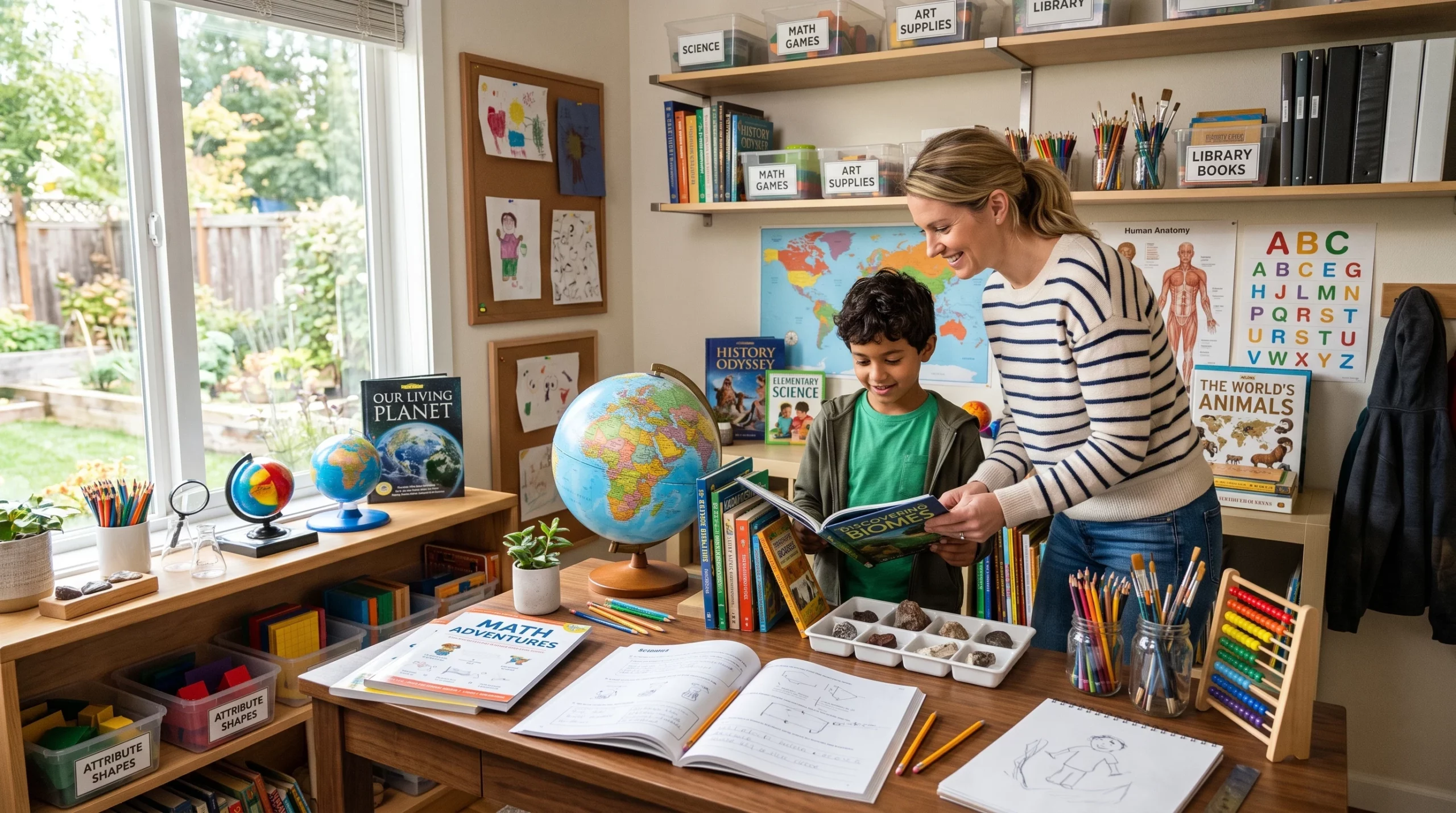
Homeschool learning doesn’t have to be limited to textbooks, worksheets, or a predetermined list of subjects. Some of the most interesting learning opportunities begin with a new experience, an unexpected question, or something that captures your child’s attention.
Learning ideas can come from everyday life, hands-on activities, nature, games, projects, hobbies, and subjects your child has never encountered before.
The goal isn’t to turn every moment into a lesson. It’s to provide opportunities for children to discover what interests them and give those interests room to grow.
For even more topics to explore, the Smithsonian Learning Lab offers free access to millions of digital resources covering science, history, art, culture, and more.
Discover What Sparks Curiosity: 100 Days of Discovery and Interest-Led Learning
Sometimes children know exactly what they’re interested in. Other times, they simply haven’t encountered the subject that will capture their attention yet.
That’s where intentional exposure to new ideas can be useful.
100 Days of Discovery
The 100 Days of Discovery printable gives children an opportunity to sample 100 different subjects, activities, and areas of interest.
Each Discovery Day introduces one topic. The activity doesn’t need to become a full lesson or unit study. It can be as simple as watching a short video, reading something together, trying a small activity, looking at pictures, having a conversation, or exploring the topic online.
Afterward, your child gives the topic an interest rating from A to F.
An A means “Rabbit Hole!”—they want to know more.
An F means the subject simply didn’t interest them.
And that’s useful information too.
The purpose isn’t to get good grades or complete all 100 topics perfectly. The ratings help you notice which subjects your child wants to explore again and which ones they’re happy to leave behind.
Explore 100 Days of Discovery →
Interest-Based Learning
Interest-based learning begins with something that has already captured your child’s attention.
Maybe they’re constantly talking about dinosaurs, wondering how plants grow, building elaborate structures, drawing characters, watching videos about space, or asking questions about how something works.
Those interests can become starting points for learning.
A question about why the sky changes color might lead to books, videos, experiments, photography, weather, or atmospheric science. An interest in dinosaurs might lead to biology, geology, geography, timelines, museums, drawing, or writing.
You don’t have to turn every interest into a formal unit study. Sometimes simply providing resources and opportunities is enough.
LINK: Explore interest-based learning →
Following Your Child’s Interests
Pay attention to what your child repeatedly chooses.
What books do they pick? What games do they play? What do they build? What videos do they watch? What do they talk about when nobody has assigned them a topic?
Those patterns can provide clues about what they might enjoy exploring more deeply.
You can support those interests by providing books, materials, documentaries, games, activities, field trips, conversations, or opportunities to meet people who know more about the subject.
Interests don’t have to last forever. A child can explore something for a week, learn from it, and move on.
LINK: Explore following your child’s interests →
Following the Rabbit Hole
Sometimes an interest doesn’t disappear after a day or two.
Instead, one question creates another.
A child who becomes curious about space might begin with planets, move into astronauts, start researching rockets, build a model spacecraft, investigate gravity, and eventually become fascinated with engineering.
That’s rabbit-hole learning.
When it happens, you don’t necessarily need to redirect your child back to a predetermined topic. Give them access to books, videos, projects, experiments, field trips, games, experts, or other resources that allow them to keep exploring.
The rabbit hole can continue for as long as the interest remains.
LINK: Explore rabbit-hole learning →
Make Learning Tangible: Hands-On, Everyday, Outdoor, and Project-Based Ideas
Learning can happen almost anywhere.
Hands-on activities, household responsibilities, outdoor exploration, games, hobbies, and larger projects can all provide opportunities to use skills and investigate ideas in practical ways.
Hands-On Learning
Hands-on learning gives children opportunities to interact directly with what they’re exploring.
They might build a structure while experimenting with engineering, measure ingredients while cooking, examine something under a microscope, create a model, grow a plant, conduct an experiment, or take something apart to understand how it works.
These experiences can help make abstract ideas easier to investigate and understand.
Encourage questions, experimentation, and even failed attempts. Figuring out why something didn’t work can become part of the learning process.
LINK: Explore hands-on learning ideas →
Everyday Learning
Learning doesn’t stop when children leave the table or close a workbook.
Cooking involves reading, measurement, fractions, chemistry, and planning. Shopping can involve budgeting, comparison, percentages, and decision-making. Maps and road signs involve reading, geography, and navigation.
Even ordinary conversations can lead somewhere unexpected.
Recognizing everyday learning doesn’t mean turning every household activity into an assignment. It simply means noticing the skills, questions, and experiences already present in daily life.
LINK: Explore everyday learning ideas →
Life Skills
Learning how to manage everyday responsibilities is an important part of growing up.
Cooking, laundry, cleaning, basic home maintenance, money management, meal planning, organization, communication, and personal responsibility can all become practical learning experiences.
The specific skills children practice can grow with them. Younger children might help sort laundry or prepare a simple snack, while older children can gradually take responsibility for more complex tasks.
LINK: Explore life skills for homeschoolers →
Nature and Outdoor Learning
The outdoors provides constantly changing opportunities for exploration.
Children can observe plants, animals, insects, rocks, weather, ecosystems, stars, seasonal changes, and the geography around them.
Outdoor learning can be as simple as noticing something interesting during a walk or as involved as keeping a nature journal, identifying species, gardening, collecting weather data, or completing a long-term observation project.
Arizona families also have opportunities to explore environments ranging from deserts and mountains to forests and riparian areas.
LINK: Explore nature and outdoor learning →
Project-Based Learning
Project-based learning allows children to explore a question, problem, or subject through a larger activity.
A project might involve research, building, experimentation, writing, art, mathematics, technology, interviews, or field experiences.
For example, an interest in ancient Egypt could include reading about daily life, locating Egypt on a map, exploring hieroglyphics, studying pyramid construction, creating art, and visiting a museum exhibit.
Projects can be simple or elaborate. What matters is giving children opportunities to investigate, create, solve problems, and make connections.
Explore project-based learning →
Games and Play-Based Learning
Play can involve a surprising amount of learning.
Board games and card games may involve reading, counting, probability, strategy, money, or negotiation. Puzzles can develop spatial reasoning and problem-solving. Role-playing and imaginative play can involve storytelling, communication, planning, and creativity.
Video games can also involve reading, strategy, resource management, building, communication, problem-solving, and other skills depending on the game.
Not every game needs to be marketed as educational to involve learning.
LINK: Explore games and play-based learning →
Fuel Exploration With New Subjects and Following a Child’s Interests
Children can’t become interested in something they don’t know exists.
Introducing new subjects gives them opportunities to discover interests they may never encounter through their usual activities.
The goal isn’t to require children to pursue everything you introduce. It’s to open doors and see which ones they want to walk through.
Exploring New Subjects
New subjects can be introduced in small, low-pressure ways.
Try a new art form. Listen to a different type of music. Look through a microscope. Learn a few words in another language. Explore mythology. Identify a rock. Try photography. Look at the night sky. Visit somewhere new.
Books, documentaries, community events, museums, virtual field trips, local experts, and simple activities can all provide introductions.
If the subject doesn’t interest your child, move on.
If it does, you’ve found somewhere new to explore.
LINK: Explore new subjects for homeschoolers →
Turning Interests Into Learning Opportunities
When a child becomes interested in something, look for ways to make additional resources available without immediately taking control of the interest.
A child fascinated by chemistry might appreciate experiments or a science kit. A dinosaur enthusiast might enjoy museum visits, fossils, documentaries, or books. A child interested in photography might want opportunities to experiment with composition, lighting, editing, or nature photography.
The goal is to support the interest rather than transform it into another required assignment.
LINK: Explore turning interests into learning opportunities →
Learning With Other People
Interests can also create opportunities to learn with other people.
Siblings, friends, homeschool groups, community organizations, clubs, classes, relatives, and local experts can introduce different perspectives and skills.
Children might work together on a project, participate in a club, attend a workshop, interview someone knowledgeable about a subject, or simply share an interest with a friend.
Not every interest needs to become a group activity, but collaboration can add another dimension when children enjoy learning with others.
LINK: Explore collaborative homeschool learning →
Where to Explore Next
Unschooling
Explore child-led and interest-led learning, rabbit-hole learning, passion projects, and ways to follow your child’s curiosity.
Curriculum & Resources
Find curriculum, books, educational games, STEM resources, hands-on materials, and other tools to support the subjects your child wants to explore.
Explore Curriculum & Resources →
Technology & Gaming
Explore video games, Roblox, Minecraft, apps, digital creativity, AI, and other ways technology can become part of learning.
Start Homeschooling
Find help choosing a homeschool approach, planning your homeschool, creating routines, and getting started.
Arizona Homeschool
Find information, activities, and resources specifically for families homeschooling in Arizona.
For Parents
Find practical support for homeschool parents, including routines, changing approaches, burnout, organization, and figuring out what works for your family.