

What if your child’s favorite hobby could become the starting point for an entirely new learning experience?
Whether your child loves video games, cooking, animals, photography, or building things, their existing interests can provide opportunities to explore academic subjects, develop practical skills, and discover new passions.
That’s the idea behind interest-led learning.
Rather than treating education and personal interests as completely separate activities, interest-led learning connects the two. Parents help children explore subjects they already enjoy while introducing related ideas, resources, and experiences.
You don’t need to abandon your current homeschooling approach or turn every hobby into an assignment. Interest-led learning can be incorporated into almost any homeschool.
This post may contain affiliate links. When you click and purchase from any of our links, we may get a small commission at no extra cost to you. For more information, please see our affiliate disclosure.
What Is Interest-Led Learning?
Interest-led learning is an educational approach that uses a child’s existing interests as the starting point for learning experiences.
Instead of choosing every topic in advance, parents observe what captures their child’s attention and look for opportunities to explore those interests more deeply.
For example, imagine your child loves building elaborate structures in Minecraft.
That interest might lead to investigating architecture, structural engineering, geometry, historical buildings, or computer programming.
You could introduce books about famous architectural structures, encourage your child to experiment with different building designs, or explore how real-world engineers solve construction problems.
The interest provides the starting point. Where the learning goes depends on your child’s curiosity and the opportunities you introduce.
Importantly, interest-led learning doesn’t require turning every enjoyable activity into an educational project.
Sometimes children simply want to enjoy their hobbies, and that’s perfectly reasonable.
How Is Interest-Led Learning Different From Child-Led Learning?
Interest-led learning and child-led learning overlap considerably, but they emphasize different aspects of education.
Child-led learning focuses on giving children meaningful influence over their educational experiences. Children participate in deciding what they learn, how they explore subjects, and which activities they pursue.
Interest-led learning specifically uses existing interests to develop educational opportunities.
Parents might identify an interest and introduce related subjects, projects, and resources while allowing their child to determine which opportunities to pursue.
Both approaches can be incorporated into traditional homeschooling, eclectic homeschooling, or unschooling.
Child-Led Learning: A Practical Guide for Homeschool Parents —>
How to Identify Your Child’s Interests
Before you can build educational opportunities around your child’s interests, you need to recognize what those interests actually are.
Sometimes they’re obvious.
Your child might spend hours building with LEGO, researching dinosaurs, drawing characters, or talking about their favorite video game.
Other interests are less obvious.
A child who enjoys organizing collections might be interested in classification, mathematics, or information management. A child who loves creating pretend stores might enjoy economics, entrepreneurship, or marketing.
Pay attention to what your child chooses to do when they have free time.
Notice the questions they ask, the subjects they talk about repeatedly, and the activities they return to without being prompted.
You can also ask questions that encourage reflection:
- What was your favorite thing you did this week?
- Is there something you’d like to learn how to make?
- What’s something you’ve always wondered about?
- If you could learn more about anything, what would you choose?
You don’t need to conduct formal interviews or document every conversation.
The goal is simply to recognize patterns and identify opportunities.
What If Your Child Doesn’t Have Any Obvious Interests?
Children can’t develop interests in subjects they’ve never encountered.
If your child consistently returns to the same familiar activities or struggles to identify anything new they’d like to explore, consider introducing unfamiliar experiences.
This is where Discovery Days can help.
My 100 Days of Discovery approach introduces children to 100 different subjects through short, low-pressure introductory activities.
Rather than requiring children to commit to a subject, each activity provides an opportunity to experience something unfamiliar and determine whether they’d like to explore it further.
The accompanying printable includes an interest-grading system that helps parents identify which activities capture their child’s attention.
You can learn more about this approach and download the free 100 Days of Discovery printable from my dedicated article.
100 Days of Discovery: Help Your Child Discover What They Love
Turning Your Child’s Interests Into Learning Opportunities
Once you’ve identified an interest, the next step is looking for natural opportunities to expand upon it.
Start by asking yourself three questions:
- What does my child enjoy most about this interest?
- What related subjects or skills could we explore?
- Which opportunities would my child actually enjoy pursuing?
The third question is particularly important.
Just because an interest has educational potential doesn’t mean your child will enjoy every related activity.
Offer possibilities rather than creating an extensive list of required assignments.
Learning Through Video Games
Video games can introduce children to a variety of subjects and practical skills.
Consider a child who enjoys building elaborate structures in Minecraft or designing environments in Roblox.
Potential learning opportunities include:
- Architecture: Investigate architectural styles and recreate famous buildings.
- Mathematics: Explore measurement, proportions, scale, and geometry.
- Engineering: Experiment with structural designs and construction techniques.
- Programming: Investigate how games are developed and experiment with beginner coding.
- Creative Writing: Develop stories and characters based on original game environments.
- Digital Art: Experiment with character design, animation, or digital illustration.
You don’t need to pursue every possibility.
Follow the connections that genuinely interest your child.
Learning Through Cooking and Baking
Cooking offers opportunities to develop academic knowledge alongside practical life skills.
A child who enjoys baking might investigate fractions, ratios, measurements, temperature, and the chemistry of different ingredients.
They could compare recipes, calculate ingredient costs, research international cuisines, or experiment with creating original dishes.
An interest in decorating cakes might lead to exploring geometry, color theory, photography, or entrepreneurship.
The possibilities depend on which aspects of cooking your child enjoys.
Learning Through Nature and Animals
A child fascinated by animals might begin with books, documentaries, or observing wildlife.
Their interest could develop into studying animal anatomy, ecosystems, conservation, habitats, or animal behavior.
A child who enjoys spending time outdoors might investigate weather patterns, geology, navigation, photography, or local ecosystems.
These experiences can also provide opportunities to practice research, writing, measurement, and observation.
Learning Through Creative Projects
Creative interests can introduce children to both artistic and technical subjects.
Photography can lead to investigating light, optics, composition, editing software, and visual storytelling.
Sewing can introduce measurement, geometry, design, budgeting, and practical problem-solving.
A child interested in filmmaking might explore writing, sound engineering, digital editing, animation, and communication.
Instead of assigning every related subject, introduce resources and opportunities as your child’s projects develop.
Connecting One Interest Across Multiple Academic Subjects
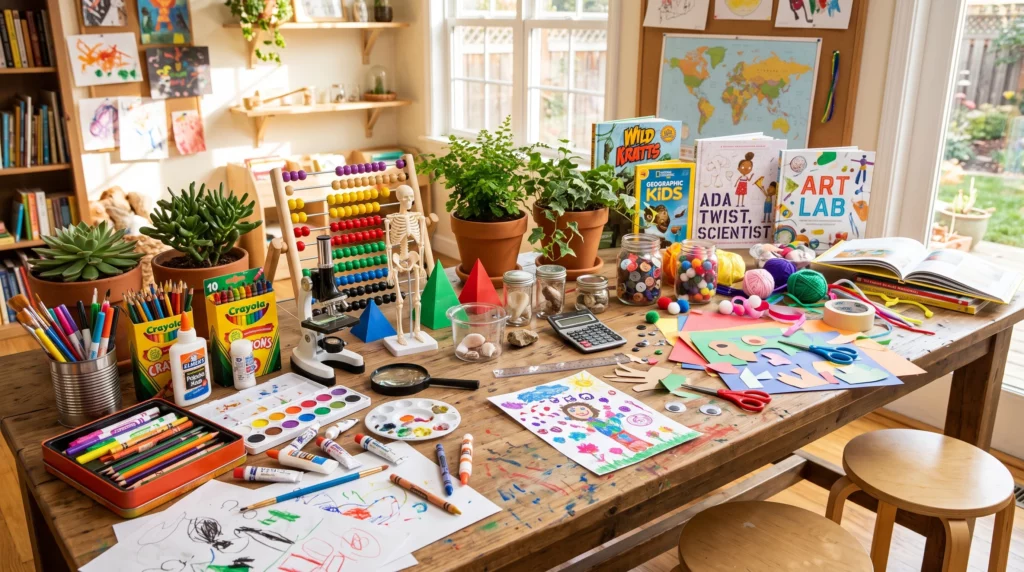
One of the advantages of interest-led learning is that a single interest can provide opportunities to explore several academic subjects.
Consider a child who loves animals.
That interest could connect to several different learning experiences.
Reading and Language Arts
Explore fiction and nonfiction books about animals.
Read field guides, investigate unfamiliar vocabulary, or research a favorite species.
Children who enjoy storytelling might write fictional adventures featuring animals or create informational booklets about their discoveries.
Mathematics
Investigate animal sizes, weights, speeds, and lifespans.
Compare measurements, create graphs, calculate feeding quantities, or explore the mathematics involved in designing animal habitats.
Science
Study anatomy, habitats, ecosystems, adaptations, life cycles, and animal behavior.
Investigate how different species interact with their environments or explore conservation challenges.
History and Geography
Research how animals have influenced different civilizations.
Explore domestication, migration patterns, historical transportation, or the geographical distribution of different species.
Practical Life Skills
Caring for a family pet can introduce responsibility, budgeting, scheduling, research, and animal husbandry.
Children might investigate appropriate nutrition, habitat maintenance, or the costs associated with animal care.
The purpose isn’t to force one interest into every academic subject.
Instead, recognize the connections that naturally exist and introduce opportunities that align with your child’s curiosity.
How to Find Resources That Support Your Child’s Interests
Interest-led learning doesn’t require purchasing an entirely new curriculum every time your child discovers something exciting.
Begin with resources you already have available.
Books, documentaries, educational websites, household materials, libraries, and community resources can provide excellent starting points.
As an interest develops, you might consider additional materials, specialized equipment, online classes, or opportunities to learn from someone experienced in the subject.
For example, a child interested in astronomy might begin with books and videos before progressing to stargazing, astronomy software, or using a telescope.
A child interested in photography might begin with a phone or an existing family camera before investigating more advanced equipment.
Let the depth of your child’s interest help determine which resources are worth pursuing.
Supporting Long-Term Interests and Passion Projects
Some interests last a few days. Others develop into hobbies or passions that continue for years.
When your child repeatedly returns to a subject, consider providing opportunities for increasingly independent exploration.
A child interested in gardening might begin by growing a few plants before designing an entire garden.
A child fascinated by video games might eventually investigate programming or create an original game.
Someone interested in cooking might progress from following recipes to developing original dishes or learning about food-related careers.
Long-term interests can also develop into passion projects.
These projects allow children to investigate something meaningful to them, establish personal goals, solve problems, and develop new skills.
Your role is to provide support without taking ownership of the project.
Homeschooling Success: Using Passion Projects to Empower Kids —>
Rabbit-Hole Learning: Following an Interest Into Something New
Interest-led learning doesn’t always follow a predictable path.
Sometimes one question leads to another, and an initial interest develops into an entirely different subject.
This is what I call rabbit-hole learning.
Imagine your child becomes interested in thunderstorms.
That interest might lead to investigating lightning, which introduces electricity.
Electricity could spark an interest in circuits, electronics, or engineering.
What began as an interest in weather might eventually develop into a passion for building electronic devices.
You don’t need to predict or plan every connection.
Provide resources, answer questions when you can, and help your child investigate the subjects that capture their attention.
LINK: Rabbit-Hole Learning: When Curiosity Leads to Deeper Learning [COMING SOON]
What Happens When Your Child Loses Interest?
Not every interest develops into a long-term passion.
Your child might spend several weeks fascinated by astronomy before suddenly becoming interested in music or architecture.
That doesn’t mean the previous experience was unsuccessful.
They’ve still encountered new information, developed skills, and discovered something about their preferences.
Pay attention when enthusiasm begins to fade.
If your child no longer wants to pursue a particular project, discuss whether they’d prefer to finish it, approach it differently, take a break, or move on.
You can also introduce new subjects through Discovery Days or revisit previous interests later.
Interest-led learning should leave room for children’s interests to change as they grow.
Balancing Interest-Led Learning With Other Homeschool Responsibilities
Interest-led learning can complement almost any homeschooling approach.
You don’t have to organize your entire homeschool around your child’s interests to benefit from it.
Traditional homeschooling families might incorporate interest-led projects alongside their regular curriculum.
Eclectic homeschoolers might combine structured resources with flexible exploration.
Unschooling families may use existing interests as a foundation for much of their educational experience.
Whichever approach you follow, consider your child’s educational needs and the homeschooling requirements that apply where you live.
Some families prefer scheduled instruction for particular subjects. Others find opportunities to explore academic concepts through their children’s interests and everyday experiences.
There isn’t one required schedule or structure for interest-led learning.
The goal is to create meaningful educational opportunities while maintaining the flexibility to follow your child’s curiosity.
How to Get Started With Interest-Led Learning
You don’t need an elaborate plan to begin.
Start by identifying one interest your child already enjoys.
Look for related subjects, skills, activities, and resources that might provide opportunities for further exploration.
Introduce one or two possibilities and observe your child’s response.
If something captures their attention, help them investigate it.
If they’re uninterested, try a different connection or allow them to continue enjoying the original activity without additional expectations.
As their interest develops, introduce more challenging resources or opportunities when appropriate.
Remember that interest-led learning doesn’t mean turning every enjoyable experience into a lesson.
Sometimes the most productive approach is providing an interesting environment, making resources available, and allowing your child to explore.
Final Thoughts
Interest-led learning begins with recognizing what your child already loves.
Those interests can become starting points for exploring unfamiliar subjects, developing academic knowledge, practicing practical skills, and discovering new passions.
Your role is to recognize opportunities, introduce possibilities, provide resources, and support your child’s curiosity.
You don’t need to turn every hobby into a curriculum or plan every educational connection in advance.
Start with one interest, explore where it might lead, and allow your child to help determine what happens next.
Resources and Links
Internal Resources
- Child-Led Learning: A Practical Guide for Homeschool Parents
- 100 Days of Discovery: Help Your Child Discover What They Love
- Unschooling — https://azhomeschoolers.com/unschooling/
- Homeschool Learning Ideas — https://azhomeschoolers.com/homeschool-learning-ideas/
- Homeschooling Success: Using Passion Projects to Empower Kids
- Rabbit-Hole Learning: When Curiosity Leads to Deeper Learning — [COMING SOON]
External Resources
- Smithsonian Learning Lab — https://learninglab.si.edu/
Educational collections covering science, history, art, culture, and other subjects. - Khan Academy — https://www.khanacademy.org/
Free educational lessons and practice across numerous academic subjects. - PBS LearningMedia — https://www.pbslearningmedia.org/
Educational videos and interactive resources covering a wide range of subjects. - Common Sense Media — https://www.commonsensemedia.org/
Reviews and information about games, apps, books, and other media.
When you click and purchase from any of our links, we may get a small commission at no extra cost to you. For more information, please see our affiliate disclosure.