
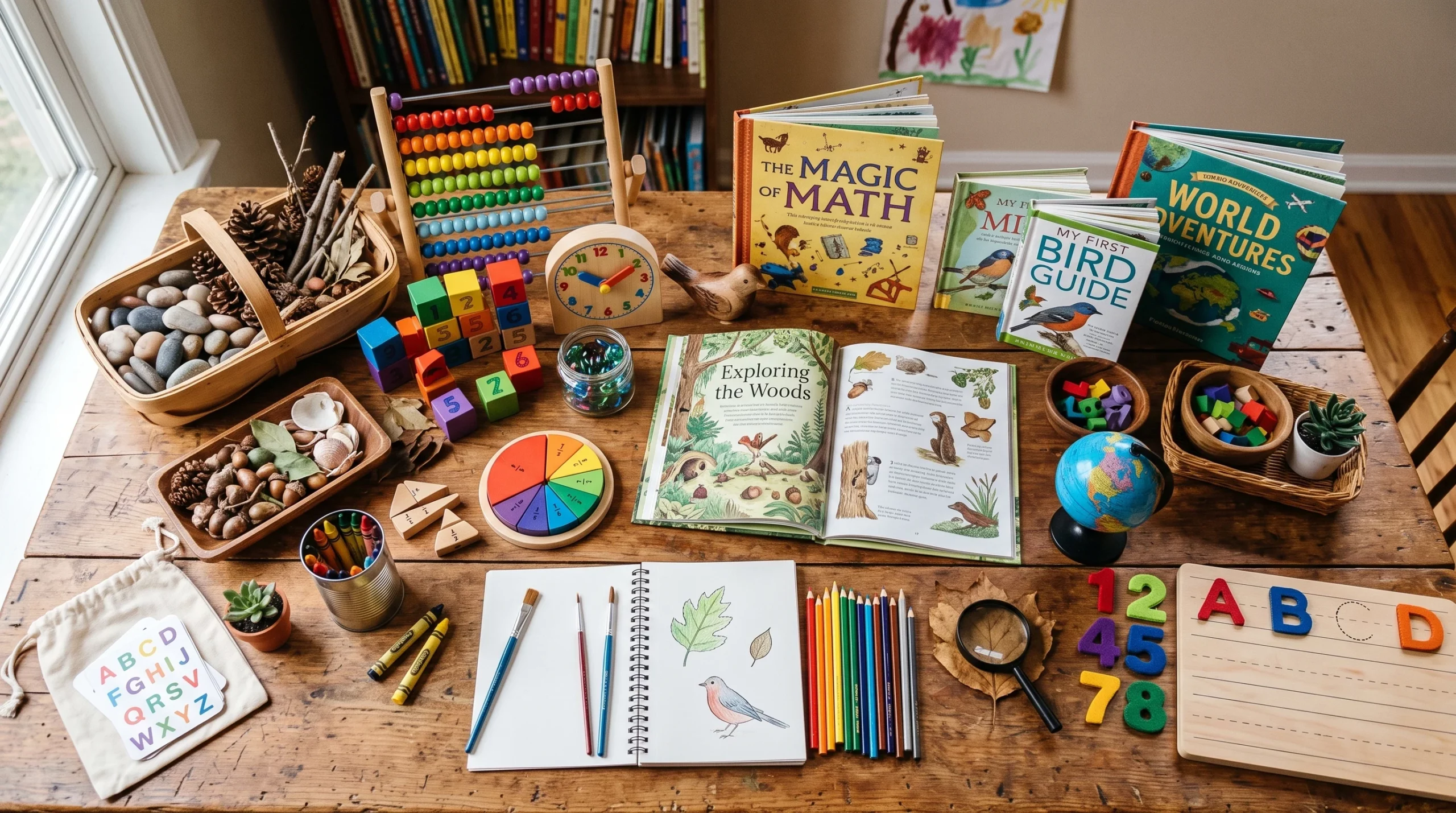
One of the biggest advantages of homeschooling is having the freedom to build an education around your child rather than expecting your child to fit into a predetermined educational system.
But what does that actually look like?
Child-led learning gives children an active role in their education. Their questions, interests, preferences, and experiences help determine what they explore and how they approach learning.
That doesn’t mean parents stop teaching, eliminate every schedule, or wait for their children to figure everything out independently.
Instead, parents become active participants in creating opportunities, introducing new subjects, providing resources, and helping their children pursue their interests.
The goal is to create an environment where children have a meaningful voice in their education while parents provide the guidance and support they need.
This post may contain affiliate links. When you click and purchase from any of our links, we may get a small commission at no extra cost to you. For more information, please see our affiliate disclosure.
What Is Child-Led Learning?
Child-led learning is an educational approach that gives children meaningful influence over their learning experiences.
Rather than following an entirely predetermined curriculum, children participate in deciding which subjects to explore, what questions to investigate, and which activities or projects interest them.
Parents remain actively involved, but their role changes.
Instead of making every educational decision, they create opportunities, introduce possibilities, provide resources, answer questions, and help children develop the skills necessary to explore independently.
For example, imagine your child becomes interested in airplanes.
You might begin by helping them build and test paper airplanes. That experience could lead to questions about aerodynamics, the history of aviation, aircraft engineering, or even learning how pilots navigate.
Your child determines which questions capture their attention, while you help them find ways to investigate those questions.
The experience becomes a collaboration rather than a predetermined sequence of lessons.
Child-Led Learning vs. Interest-Led Learning vs. Unschooling
These three approaches share several characteristics, and families often incorporate elements of all three. However, they aren’t interchangeable.
Child-Led Learning
Child-led learning emphasizes giving children meaningful choices about their education.
Children influence what they learn and how they explore it, while parents remain involved in providing resources, introducing subjects, and establishing whatever structure their family needs.
Interest-Led Learning
Interest-led learning specifically uses a child’s interests as the starting point for educational experiences.
For example, a child fascinated by dinosaurs might explore prehistoric ecosystems, geology, scientific illustration, and the history of paleontology.
The child’s interest connects different subjects and provides opportunities for deeper exploration.
Interest-Led Learning: How to Build Learning Around What Your Child Loves
Unschooling
Unschooling is a broader educational philosophy that emphasizes learning through everyday experiences, curiosity, personal interests, relationships, and engagement with the world.
Unschooling families generally move away from compulsory lessons and predetermined academic schedules. However, parents can still introduce subjects, arrange educational experiences, and actively support learning.
Unschooling doesn’t mean children must discover everything without assistance.
Explore Our Unschooling Resources
The Parent’s Role in Child-Led Learning
One of the most important things to understand about child-led learning is that children don’t have to be responsible for discovering every educational opportunity themselves.
Parents play an essential role in expanding their children’s experiences.
Think about the enormous number of subjects, occupations, hobbies, technologies, scientific fields, and practical skills your child hasn’t encountered yet.
How can children express an interest in something they don’t know exists?
That’s where parents come in.
You can introduce unfamiliar subjects, visit interesting places, demonstrate new skills, provide educational materials, and share your own interests.
Your child then has opportunities to discover which experiences capture their curiosity.
Introduce New Subjects and Experiences
Regularly introduce your child to something unfamiliar.
This might involve investigating how electricity works, exploring a historical civilization, experimenting with photography, learning basic navigation, or examining how everyday objects are constructed.
These introductions don’t need to become formal lessons.
Sometimes a brief activity or interesting conversation is enough to determine whether a subject deserves further exploration.
Provide Resources and Opportunities
When your child becomes interested in something, help them access the resources they need.
Depending on the subject, that might mean books, educational videos, games, equipment, experiments, classes, field trips, or conversations with knowledgeable people.
You don’t need to purchase an entire curriculum every time your child develops a new interest.
Start with what’s available and expand when there’s a reason to do so.
Give Children Meaningful Choices
Providing choices doesn’t require giving children complete control over every aspect of their education.
You might offer several possible activities, let your child choose how to investigate a subject, or involve them in deciding which resources to use.
As children develop independence, they can take greater responsibility for planning projects, researching questions, and identifying what they want to learn next.
What If Your Child Doesn’t Know What They’re Interested In?
One of the challenges of child-led learning is figuring out where to begin when your child doesn’t know what they want to explore.
It’s easy to suggest following your child’s interests, but that advice isn’t particularly helpful when your child doesn’t know what those interests are.
Children naturally gravitate toward familiar activities and experiences. Without opportunities to encounter something new, they may never discover subjects they would genuinely enjoy.
That’s why introducing unfamiliar subjects is an important part of my approach.
Rather than waiting for interests to appear, parents can provide opportunities for children to discover them.
Introducing Discovery Days
This challenge inspired my 100 Days of Discovery approach.
Discovery Days are short, low-pressure introductions to subjects your child may never have encountered before.
Each activity introduces something different, from engineering and astronomy to history, business, art, and practical life skills.
The purpose isn’t to master the subject or complete an elaborate project. It’s simply to introduce something unfamiliar and observe your child’s response.
After each activity, parents record an interest grade.
An A indicates a strong interest worth exploring immediately. A B suggests something worth revisiting. Lower grades indicate varying degrees of interest, including subjects your child doesn’t currently want to pursue.
These grades measure interest, not academic performance.
Even an F provides useful information because you’ve learned something about your child’s preferences.
I’ve created a free 100 Days of Discovery printable containing all 100 introductory activities, an interest-grading system, space for observations, and an end-of-discovery review.
Visit the complete Discovery Days guide to learn how the system works and download your free printable.

What Does Child-Led Learning Look Like in Everyday Life?
Child-led learning doesn’t require elaborate projects or expensive educational materials.
Many opportunities begin with ordinary activities.
Learning Through Cooking
Your child decides they want to prepare dinner.
That experience might involve reading recipes, measuring ingredients, adjusting quantities, comparing prices, investigating food safety, and experimenting with cooking techniques.
Perhaps they become interested in baking bread and want to investigate how yeast works.
One everyday activity can create several opportunities for learning.
Learning Through Gardening
A child who wants to grow something might begin by selecting seeds.
They could investigate soil, germination, watering, sunlight, insects, weather, and plant growth.
They might also measure garden beds, calculate planting distances, document growth, or investigate why certain plants thrive while others struggle.
Learning Through Video Games
Video games can also provide opportunities for child-led learning.
A child interested in designing buildings within a game might begin investigating architecture, structural engineering, city planning, or interior design.
Another child might become interested in programming, animation, digital art, or game development.
The important distinction is recognizing potential learning opportunities without insisting that every recreational activity must become an educational assignment.
Learning Through Creative Projects
Photography, filmmaking, storytelling, music, and art can introduce children to technical and creative subjects.
A child who wants to make a short film might investigate lighting, sound recording, editing, storytelling, photography, and digital technology.
You can provide the resources and guidance while allowing your child to make creative decisions.
Balancing Child-Led Learning With Your Homeschool Responsibilities
Child-led learning doesn’t require abandoning educational planning.
Families can incorporate it into structured, flexible, or completely interest-based approaches.
The amount of structure depends on your educational philosophy, your child’s needs, and any legal requirements that apply to your family.
Some families maintain scheduled instruction for certain subjects while reserving time for independent exploration.
Others use their children’s interests to organize much of their educational experience.
The important thing is finding an approach that gives children meaningful opportunities to direct their learning while allowing parents to fulfill their responsibilities.
Common Challenges With Child-Led Learning
My Child Only Wants to Explore One Subject
Children sometimes develop intense interests that last for weeks, months, or longer.
Rather than immediately redirecting their attention, investigate how much learning is happening within that interest.
Look for opportunities to explore related subjects, introduce new resources, and encourage increasingly challenging projects.
You can continue offering exposure to other subjects without requiring your child to abandon something they genuinely enjoy.
My Child Doesn’t Want to Try Anything New
Start small.
Introduce unfamiliar subjects through brief experiences rather than lengthy lessons.
Look for connections to familiar interests, and allow your child to participate in choosing which activities to try.
Don’t turn every introduction into an obligation.
Sometimes an unsuccessful activity simply means the subject, timing, or approach wasn’t a good fit.
How Do I Know My Child Is Actually Learning?
Learning doesn’t always produce completed worksheets or easily measurable results.
Look for questions, conversations, experiments, new skills, problem-solving, independent research, and the ability to apply knowledge.
Photographs, project samples, reading lists, and brief observational notes can help you recognize and document learning over time.
How to Start Child-Led Learning in Your Homeschool
You don’t need to redesign your entire homeschool immediately.
Begin by observing what already interests your child.
Pay attention to the activities they choose independently, the questions they ask, and the subjects they return to repeatedly.
Then introduce additional opportunities.
Offer unfamiliar activities, visit new places, share interesting information, and provide access to different materials.
When something captures their attention, help them investigate it.
Give your child opportunities to make decisions about their projects and educational experiences.
Finally, periodically review what’s working.
Interests change, educational needs evolve, and the approach that works today may need adjusting later.
Child-led learning is an ongoing process of introducing opportunities, observing interests, supporting exploration, and adapting as your child grows.
Final Thoughts
Child-led learning isn’t about parents disappearing from the educational process.
It’s about creating a partnership in which children have meaningful influence over their education.
Parents introduce possibilities, provide resources, support exploration, and help children develop independence.
Children bring their questions, curiosity, preferences, and interests.
You don’t have to know where every interest will lead.
Sometimes the most valuable thing you can do is introduce something unfamiliar and see what happens.
Resources and Links
Internal Resources
- Unschooling — https://azhomeschoolers.com/unschooling/
- Homeschool Learning Ideas — https://azhomeschoolers.com/homeschool-learning-ideas/
- 100 Days of Discovery: Help Your Child Discover What They Love Article
- Homeschooling Success: Using Passion Projects to Empower Kids
- Deschooling: A Vital Transition to Homeschooling Life
- Interest-Led Learning: How to Build Learning Around What Your Child Loves
- Rabbit-Hole Learning: When Curiosity Leads to Deeper Learning — [COMING SOON]
External Resources
- Smithsonian Learning Lab — Educational collections and resources for exploring new subjects.
- Khan Academy — Free educational lessons and practice.
- PBS LearningMedia — Educational videos and interactive learning resources.
- Alliance for Self-Directed Education — Information and resources about self-directed education.
When you click and purchase from any of our links, we may get a small commission at no extra cost to you. For more information, please see our affiliate disclosure.